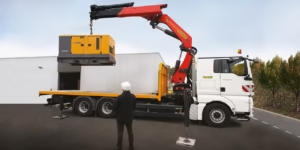
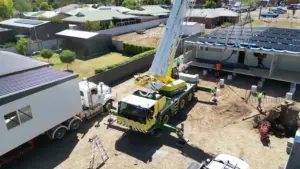
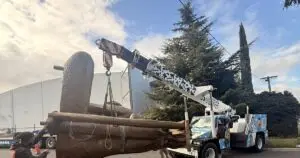
What is a lift plan?
A lift plan (sometimes called a lift study or crane lift plan) is a documented plan for how a crane lift will be carried out safely. It sets out the crane to be used, where it will set up, how the load will be rigged, the path the load will travel, and the controls that keep people and property out of harm’s way. Every professional crane lift is planned — the lift plan is simply that planning written down so everyone on site is working from the same picture.
What’s included in a lift plan?
A typical lift plan covers:
- The load — what’s being lifted, its weight, dimensions, and centre of gravity
- The crane — make, model, configuration, boom length, and counterweight, with the lift checked against the crane’s load chart at the required radius
- Crane position and set-up — where the crane sits, outrigger loads, and ground conditions (including packing or bog mats if the ground needs support)
- Rigging — slings, chains, shackles, and lifting points, with capacities
- The lift path — where the load travels, clearances from structures and powerlines
- Exclusion zones — areas where no one stands during the lift
- People and communication — who is operating, dogging or rigging, and supervising, and how they communicate (whistles, radio, hand signals)
- Site-specific hazards — overhead services, wind limits, traffic, adjacent buildings
When is a lift plan required?
In practice, every crane lift should be planned, and a competent crane company plans even simple lifts as part of the job. A documented lift plan becomes especially important — and is generally expected by principal contractors, site managers, and insurers — when any of these apply:
- The lift uses a significant percentage of the crane’s rated capacity at the working radius
- The lift is near overhead powerlines or other services
- The load travels over (or near) occupied buildings, public areas, or roads
- Two cranes share the load (dual or tandem lift)
- The load is unusual — awkward shape, unknown weight, fragile, or high value
- Ground conditions are questionable (fill, trenches, basements, sloping sites)
- The site requires it — most commercial builders require a lift plan and SWMS before any crane mobilises
On commercial sites in Victoria, crane work is typically classed as high-risk construction work, which means a Safe Work Method Statement (SWMS) is required as well — see below.
Standard vs engineered lift plans
For routine lifts, the crane company’s lift supervisor or operator prepares the lift plan from site information and a site assessment. For critical lifts — heavy lifts close to capacity, dual-crane lifts, lifts over occupied structures, or complex rigging — an engineered lift plan may be prepared, with input from an engineer, scaled drawings of the crane position and radius, and calculated outrigger loadings. Your crane company will tell you which your job needs; the difference matters for both safety and lead time.
How does a lift plan relate to a SWMS?
They work together but do different jobs. The SWMS is a safety document required for high-risk construction work — it identifies the hazards of the activity and the controls for each. The lift plan is the technical plan for the specific lift. On most commercial jobs you’ll need both, and the crane company normally supplies both as part of wet hire. If you’re managing a site, keep copies of each on file before the crane arrives — along with operator high-risk work licences and the company’s insurance certificates. (We cover the full pre-crane paperwork checklist in an upcoming post.)
Who is responsible for the lift plan?
The crane contractor prepares and owns the lift plan for wet hire jobs, and the lift supervisor confirms on the day that site conditions match the plan — if anything has changed (ground, weather, access), the plan is revised before the lift goes ahead. As the client or site manager, your job is to provide accurate information up front: load details, site access, and anything unusual about the site. Accurate information in means a safe, efficient lift out.
Booking a hire crane?
Combination Cranes & Transport prepares the lift plan and SWMS for every job - Built on decades of lifting experience
FAQ
What is a lift plan?
A lift plan is a documented plan for carrying out a crane lift safely. It covers the load, the crane and its configuration, ground conditions, rigging, the lift path, exclusion zones, and the roles of the crew performing the lift.
Is a lift plan a legal requirement?
Crane lifts must be planned and carried out safely under Victorian OHS law, and on commercial sites crane work is generally high-risk construction work requiring a SWMS. Most principal contractors also require a documented lift plan before a crane mobilises. Your crane company prepares these as part of wet hire.
Who prepares the lift plan?
For wet hire, the crane company prepares it — usually the lift supervisor or operator, with engineering input for critical lifts. The client's role is to provide accurate load and site information.
What is a critical lift?
A lift that needs extra planning — for example lifts at a high percentage of crane capacity, dual-crane lifts, lifts over occupied structures, or lifts near powerlines. These usually call for an engineered lift plan with drawings and calculated outrigger loads.