
A Franna crane lifts the load and drives it to where it’s needed. No outriggers, no set-up time, and it fits where bigger cranes can’t get in. Tell us the weight and the access and we’ll have the right one on site with a licensed operator.
Home » Services » Crane Hire » Franna Crane Hire
A Franna crane — properly a pick and carry crane — is a mobile, single-engine crane built to lift a load and travel with it. No outriggers to deploy, no set-up, and an articulated chassis that steers through spaces a slewing crane cannot reach. It is one of the most common cranes on Australian sites for exactly that reason.
“Franna” is a brand name that became the category, much like Esky or Ute. The original Australian manufacturer (now a Terex brand) made the format so common that almost any articulated pick and carry crane gets called a Franna. We supply them across Australia, wet hire only, with a licensed operator and a dogman where the lift needs one.
Want the background rather than the hire detail? Read What Is a Franna Crane and What Is It Used For?
Shifting equipment around job sites, workshops and factories — indoors and out, without breaking the load down.
Lifting off the back of a truck and carrying straight to the point of use, no forklift needed at the destination.
Production line and machinery installs where the crane has to work inside the building.
Feeding members to the main crane, or handling the lighter steel itself on smaller frames.
Rear-access blocks, driveways, car parks and inner-suburban sites where a slewing crane cannot set up.
Where the lift needs extra crew, we supply them with the crane — see Riggers & Dogmen Hire.
Not sure? That’s what the free site inspection is for. We’ll tell you honestly which one fits — even if it’s not the option you rang about.
| You need | Best fit | Why |
|---|---|---|
| Move a load around a site, or lift and travel with it — tight access, indoors, no room to set up | Franna (pick and carry) | No outriggers, drives while loaded, small footprint. Fastest on and off site. |
| Lift from one position with reach or height — rooftop plant, steel to height | Mobile slew crane | Sets up on outriggers and rotates. Far better reach-to-capacity. |
| Deliver a load and place it in one movement | Crane truck (hiab) | Crane and transport in one vehicle. No separate haulage. |
| Very heavy picks, long duration, or soft ground | Crawler crane | Tracks spread the load and it can travel rigged. |
A Franna is usually the fastest and most cost-effective choice when you need to lift and move loads up to around 40 tonnes on reasonable ground. For heavier lifts, longer reach, or confined single-position lifts, a slewing mobile crane will suit better — and we’ll say so.
Pick and carry cranes run from about 12 tonne to 40 tonne capacity. Which one suits comes down to load weight, lift height, load dimensions and — more often than anything else — site access.
Access is usually the deciding factor rather than capacity. As a guide, Franna widths run from about 2.5 m to 2.75 m, with boom-stowed travel heights from about 2.6 m to 3.5 m — compact enough to work inside many factories and warehouses. If you can tell us the narrowest gap and the lowest overhead on the route in, we can rule machines in or out immediately.
Workshop and factory work, truck loading, plant moves in confined space. The class that fits through most industrial roller doors.
The general-purpose middle. Steel erection support, machinery installs, most residential and commercial site work.
The largest pick and carry class. The Franna AT40 carries roughly 44% more load moment capacity than a MAC 25, and its three-axle design removes the need for a removable counterweight — the third axle lifts on site for a tighter turning circle.
Capacity is set by the load chart, not the badge. Every pick and carry crane has a manufacturer’s chart for that model, and rated capacity is only available at minimum radius. As boom length, boom angle and load radius increase, safe working load comes down — and the weight of chains, slings and spreader bars counts towards the load. The operator keeps every lift inside the chart for that machine.
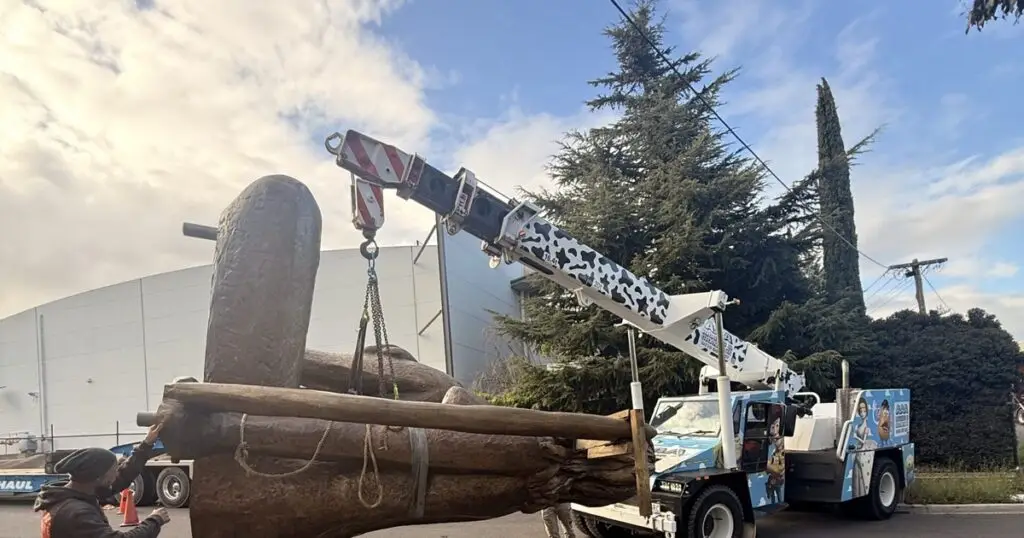
Give Roy a call to organise your franna crane lift or to discuss if a franna crane is right for your job.
Tell us about your project — We’ll work out how we can get it done for you.
Because a Franna lifts and travels at the same time, stability is managed differently to a crane that sets up on outriggers. The operating principles that matter:
Keeping the boom tips as close to the ground as the job allows.
The crane side-tilts as it steers, moving the hook towards the direction of articulation — so steering angle is kept down under load.
Wherever possible, especially when articulated. A load suspended on the downhill side increases the working load radius.
Swing sharply reduces stability. Taglines prevent pendulum motion, and travel and crane movements are applied gently.
Every Franna is run by a licensed crane operator holding the relevant high risk work licence, with a qualified dogman or rigger slinging the load and directing the lift. Near powerlines, an electrical spotter maintains safe clearances.
Indicative rates in metro capitals vary depending on the truck required, with a minimum call-out that includes travel. Larger capacity classes and out-of-hours work move it up. Check out more details on our guide to crane hire pricing
No — we supply wet hire only, which means the crane always arrives with a licensed operator, and a dogman or rigger where the lift needs one. Dry hire means you take the machine and supply your own licensed personnel, and it is where insurance and responsibility tend to fall between the cracks. If dry hire is genuinely what you need, we’d rather tell you straight than take the booking.
Capacity classes run from about 12 to 40 tonne. Weight matters, but access usually decides it — widths are around 2.5 to 2.75 m and stowed travel heights around 2.6 to 3.5 m, so the narrowest gap and lowest overhead on the route in often rule machines out before capacity does. Tell us the weight, the destination and the access and we’ll match it.
Yes — that is the whole point of a pick and carry crane. It can travel up and down grades and manoeuvre around corners under load, always subject to ground conditions and the load chart for that machine. Load swing and articulation angle are managed carefully while travelling.
No. Pick and carry cranes work without outriggers, which is why they set up in minutes and suit sites with no room to deploy. Stability is managed through boom length, articulation angle, load position and controlling swing instead.
Not for lifts performed entirely within private property. If the crane works from a road, footpath or nature strip, a council road occupation permit and traffic management are required — we arrange both. See Permits & Planning.
Generally there is a minimum 4 x hour hire booking, usually including travel to and from site. Short lifts are charged at the minimum; longer bookings give a better effective hourly rate.