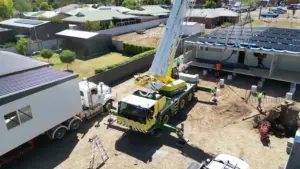
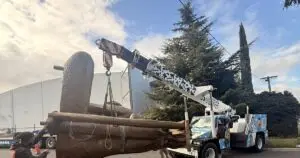
A crane truck is a truck with a hydraulic knuckle-boom crane mounted behind the cab — often called a hiab, after the Swedish manufacturer whose cranes made the format common. It carries the load and places it, in one vehicle, on one visit. No separate crane, no separate transport.
That combination is why crane trucks handle so much of the day-to-day lifting on Australian sites: freight into tight yards, machinery onto pads, shipping containers, structural steel to first-floor level, marquees and staging. This guide covers how the lift actually works, why outriggers decide what you can lift, and when a crane truck semi is the better choice.
What is a crane truck?
A crane truck is a standard truck chassis with a crane mounted on it — a boom and hoist system with controls that let the operator lift, slew and place a load accurately. Because the crane travels with the load, it suits jobs where the item has to be both moved and positioned.
Typical work includes:
- Steel erection support and first-floor placements
- Plant and equipment moves
- Air-conditioning and rooftop installations
- Pipe, ductwork and general industrial site work
- Shipping container loading, unloading and repositioning
- Breakdown recoveries and service call-outs
The appeal is mostly about time. A crane truck gets close to the work area, sets up in minutes rather than hours, and handles medium lifts without the mobilisation a larger mobile crane needs.
What is a crane truck semi?
A crane truck semi is a crane mounted on a prime mover and semi-trailer configuration. Same working principle, more capability:
- Higher lift capacity
- More reach and more boom configuration options
- Longer-distance transport in the same movement
- Multiple travel-and-pick set-ups across a large site
It suits construction work with heavier components, industrial jobs with larger assemblies, and lifts where the load has to travel a long way before it goes anywhere near a hook. Capacity always has to be verified against the load chart for the specific machine — a semi configuration is not automatically the higher-capacity option at every radius.
How does a crane truck lift actually work?
Machines vary by manufacturer, but nearly every crane truck lift follows the same sequence.
1. Positioning. The operator brings the truck into the work zone and sets up where the crane can reach the pick and the set point without repositioning mid-lift. Where the truck sits often matters more to the outcome than the size of the crane.
2. Deploying outriggers. Outriggers (stabilisers) extend to spread the load and stop the unit tipping. They are set to the configuration the lift requires, on ground that can carry the point loads — packing or matting where it can’t.
3. Boom operation. The operator extends and angles the boom to set lift height, reach and the hook path to the set point.
4. Hoisting. The hoist raises and lowers the hook block under load.
5. Slewing. Most crane truck rigs can slew — rotate the boom — to move a load horizontally without repositioning the truck for every pick. On a multi-drop job this is where most of the time saving comes from.
6. Rigging and placement. The operator and a qualified dogman or rigger work together on sling angles, shackles, hooks and spreader bars where the load needs them, then land the load.
Every crane truck is operated by a licensed crane operator holding the relevant high risk work licence, working with a dogman or rigger who slings the load and directs the lift. Where the work is near powerlines, an electrical spotter maintains safe clearances.
Why outriggers decide what you can actually lift
This is the part most people are surprised by. A crane truck’s rated capacity is not a single number — it is a set of numbers from the manufacturer’s load chart, and the chart only applies if the crane is set up the way the chart assumes.
Three things move the figure:
- Outrigger deployment. Partially deployed outriggers mean reduced capacity. Full deployment needs physical room, which is why site access affects what you can lift, not just whether the truck fits.
- Radius. Capacity drops sharply as the load moves further from the crane’s centre of rotation. A load a crane lifts easily at 3 m may be well outside the chart at 10 m.
- Boom length and angle. A shorter boom generally means higher capacity but less reach. A longer boom buys height and distance and gives capacity back.
Rigging weight counts towards the load, too. Chains, slings and spreader bars are routinely left out of the estimate and it is one of the more common reasons a lift has to be reconfigured on the day.
Crane truck or crane truck semi — which suits your job?
- Crane truck — efficient lifting with strong mobility and quick site access, for moderate loads. The default for most deliver-and-place work.
- Crane truck semi — heavier lifting, more reach options, or long-distance haulage efficiency in the same movement.
In practice the decision comes down to the specifics rather than the category: load weight including rigging, pick radius, lift height, ground conditions, and whether the outriggers can fully deploy where the truck has to stand.
What to have ready when you book
You will get a faster and far more accurate quote if you can tell us:
- Weight and dimensions of the load, including rigging
- Where it is being picked up from, and where it has to be set
- The distance from where the crane can stand to the set point
- Any height or overhead clearance restrictions
- Site access, ground type, and whether outriggers can fully deploy
Photos of the site help more than anything else on that list. A picture of the access and the set point usually answers three of those questions at once.
Why matching the rig properly saves money
An undersized or wrongly configured crane truck costs more than the hire rate difference. A correctly matched rig means fewer reattempts, safer lifts because the set-up stays inside the load chart, faster placements, less disruption to the rest of your site, and a crew that isn’t standing around. The right machine doesn’t just lift — it keeps your programme intact.
Do you need a permit?
Not for lifts performed entirely within private property. If the truck has to set up on a road, footpath or nature strip, a council road occupation permit and traffic management are required, and oversize loads need a permit from the state road authority — VicRoads in Victoria. See Do You Need a Council Permit to Set Up a Crane on the Road in Melbourne? for how that process runs.
Next steps
If you know the load weight, the height and the radius, you are most of the way to knowing what you need. Send those three numbers and a photo of the site and we’ll tell you which rig fits.
More detail on hire and pricing: Crane Truck Hire · How Much Does Crane Hire Cost in Melbourne? · Permits & Planning
Need a crane truck for your job?
Combination Cranes & Transport gives fixed, no-surprise quotes — and we handle permits and traffic management when the job needs them. Call 0419 150 698 or request a free site inspection and quote online.
Need to hire a crane truck?
Combination cranes & Transport can provide you a quote to get your project done on time, and budget - and we handle permits and traffic management when the job needs them