
Tell us the weight, the height and the reach. We’ll work out which crane the job actually needs, supply it with a licensed operator, and handle the permits — so nobody finds out on the day that the crane is too small.
Home » Services » Crane Hire » Mobile Crane Hire
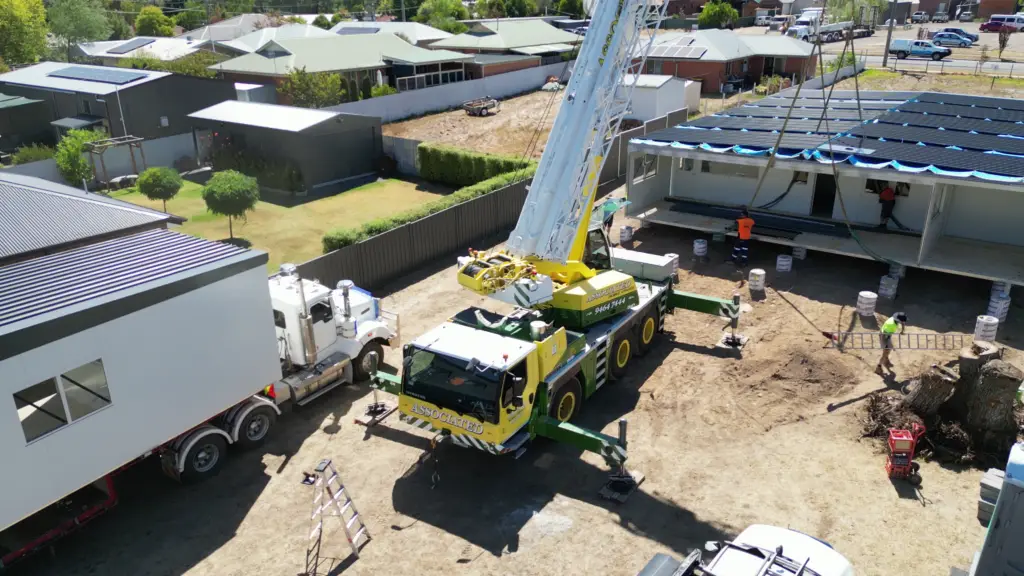
A mobile slew crane is a crane on a mobile chassis that sets up on outriggers, lifts, and rotates — slews — to place the load without moving the machine. It is the right tool when the lift happens from one position: rooftop plant, structural steel, equipment installs, confined sites where nothing else fits.
We supply mobile cranes across Australia, wet hire only, with a licensed operator and a dogman or rigger where the lift calls for one. The part we spend most time on is the bit that goes wrong most often — making sure the crane that turns up is the right size for the load, the reach and the ground it has to stand on.
Condensers and package units lifted from street level onto roofs and plant decks, often over an obstruction and usually with a permit.
Beams, columns and roof trusses placed onto the frame. Sized for radius and height together, not weight alone.
Compressors, generators, tanks and production equipment landed onto pads and plinths inside a tolerance.
Bathroom pods, plant rooms and prefabricated sections placed to line and level.
Tight lanes, rear-access blocks and sites where a crane truck can’t reach and a crawler can’t get in.
Tower sections, antennas and headframe work — specialised lifts with strict clearance requirements.
| You need | Best fit | Why |
|---|---|---|
| Lift from one position, with reach or height — rooftop plant, steel, equipment installs | Mobile slew crane | Sets up on outriggers and rotates to place loads around it. Best reach-to-capacity of the mobile options. |
| Deliver a load and place it in one movement | Crane truck (hiab) | Crane and transport in one vehicle. No separate haulage, fast set-up. |
| Move a load around a tight site, or lift while travelling | Franna (pick and carry) | Small footprint, drives while loaded. Suits factories, workshops and cramped sites. |
| Long-duration work, very heavy picks, or soft ground | Crawler crane | Tracks spread the load and it can travel while rigged. Slower and costlier to mobilise. |
Not sure? Ring 0419 150 698 and we’ll tell you which one fits — even if it isn’t the one you rang about. See also all crane hire options.
Not sure? That’s what the free site inspection is for. We’ll tell you honestly which one fits — even if it’s not the option you rang about.
The most common misconception in crane hire is that crane size is decided by the weight of the load. It isn’t. Size is decided by weight plus radius plus height plus boom configuration plus ground conditions, and radius is usually the factor that forces the size up.
These are the five numbers that decide it:
Start with the heaviest single item, then add the lifting gear: slings, shackles, spreader bars, lifting beams. Rigging weight is the most commonly forgotten figure in crane sizing, and on a marginal lift it is the one that pushes the job outside the load chart.
Measured from the crane’s centre of rotation to the centre of the load. Small radius, good capacity. Large radius, sharply less. A modest load at long reach often needs a much bigger crane than people expect — reach, not weight, is what most often decides the machine.
Height to the hook, height to the set point if they differ, and any clearance needed over an obstruction. The higher the lift at a given radius, the more capacity falls away.
A longer boom or a fly jib buys height and reach and gives capacity back at outreach. Some configurations only exist on certain crane classes, which can move the whole job up a size.
Room for outriggers to fully deploy, ground bearing capacity, matting where the ground is soft, and access width and height for the machine to get in at all. A crane’s rated capacity is only real if the site allows the set-up the load chart assumes. Partially deployed outriggers mean reduced capacity, which is why access affects what you can lift — not just whether the truck fits through the gate.
Work those out and you have effectively sized the job. If you’d rather not, send us the weight, the height and the radius and we’ll do it — that is what the free site inspection is for.
Longer read: What Size Mobile Slew Crane Do I Need?
The crane positions where it can reach both the pick and the set point, then extends outriggers to spread the weight and resist tipping. Matting goes down where the ground needs it.
Boom length and angle are set for the height and reach the lift requires, within the load chart for that exact configuration.
The dogman or rigger slings the load and directs the lift. The hoist raises it under load monitoring.
The boom rotates to bring the load over the set point and lands it — without repositioning the machine.
Every lift runs to the manufacturer’s load chart for that machine, keyed to boom length, boom angle, radius and outrigger configuration. Capacity is only valid for the configuration the chart describes, which is why we ask for the numbers up front rather than on the day.
Where a lift needs formal documentation, see What Is a Lift Plan and When Do You Need One?

Give Roy a call to organise your mobile crane lift or to discuss if a mobile crane is right for your job.
Tell us about your project — We’ll work out how we can get it done for you.
Every mobile crane we supply comes with a licensed operator, and a dogman or rigger where the lift needs one. We don’t do dry hire. Three reasons:
The operator is the person who reads the load chart, checks the ground, watches the overhead, and calls a lift off if it isn’t right. That is not a decision to hand to the customer.
One number for the whole job. If something changes on site, you ring us — you’re not ringing three companies to work out whose problem it is.
Operator licence, crane insurance, rigger ticket — all verified and lining up before the job starts. Dry-hire arrangements are where claims fall between the cracks.
Indicative rates in metro capitals vary depending on the truck required. Bigger crane classes, long reach, matting, traffic management and out-of-hours work all move it up. Send through the specifics of your job for a quote.
It depends on five things together: the heaviest load including rigging, the radius from the crane to the load, the lift height, the boom configuration, and whether the site allows outriggers to fully deploy. Weight alone won’t tell you — a light load at long reach can need a much bigger crane than a heavy load close in. Send us the weight, height and radius and we’ll size it.
Minimum call-out is 4 hours for a mobile crane, which usually includes travel to and from your site. Short lifts are charged at the minimum; longer bookings achieve a better effective hourly rate.
Yes. Every crane is wet hire — the rate includes a licensed crane operator, and a dogman or rigger where the lift requires one. We don’t offer dry hire.
Not for lifts performed entirely within private property. If the crane sets up on a road, footpath or nature strip, a council road occupation permit and traffic management are required, and oversize movements need a VicRoads permit. We arrange all of it — see Permits & Planning.
For standard weekday lifts in metro Melbourne, 3–5 business days is comfortable, and same-day is often possible. If the lift needs a road occupation permit, allow two to four weeks for council approval. TO CONFIRM — lead times, Roy intake
We mat it. Outriggers concentrate a lot of weight into a small footprint, so soft or unproven ground gets matting or packing to spread the point loads. It’s assessed at the site inspection rather than discovered on the day — which is the main reason the inspection is worth doing.
Weekend, night and public-holiday work usually attracts a loading, and it’s shown in the quote rather than buried in it. TO CONFIRM — loading %, Roy intake
Those three numbers and a photo of the site are usually enough for us to tell you what crane you need. Ring Roy on 0419 150 698 or click the link below